


As of October 2026, GitHub Copilot costs $0 on Free, $10 a month on Pro, $39 on Pro+ and $100 on Max, with Business at $19 and Enterprise at $39 per user per month. Copilot pricing changed more in 2026 than in the three years before it. There is now a $100 Max plan, premium requests are gone, and every plan is metered in GitHub AI Credits. This guide covers what each plan costs, what the credits actually buy, where Copilot Free runs out, which plan a startup team should be on, how the cost compares with Cursor and Claude Code, and the routes that get you Copilot for nothing.
GitHub Copilot Plans at a Glance
As of October 2026, GitHub sells five Copilot plans to individuals and two to organizations. Prices are in USD per month, and credit allowances are per user per month. One AI credit is worth $0.01, so 1,500 credits is $15 of model usage.
| Plan | Price | AI credits included | Who it is for |
|---|---|---|---|
| Copilot Free | $0 | Small allowance, 2,000 completions | Trying Copilot out |
| Copilot Student | $0 (verified students) | Allowance, unlimited completions | Students via GitHub Education |
| Copilot Pro | $10 / month | 1,500 (1,000 base + 500 flex) | Individual developers |
| Copilot Pro+ | $39 / month | 7,000 (3,900 base + 3,100 flex) | Daily agent users |
| Copilot Max | $100 / month | 20,000 (10,000 base + 10,000 flex) | All-day agentic work |
| Copilot Business | $19 / user / month | 1,900 per user, pooled | Teams in a GitHub organization |
| Copilot Enterprise | $39 / user / month | 3,900 per user, pooled | Companies on GitHub Enterprise Cloud |
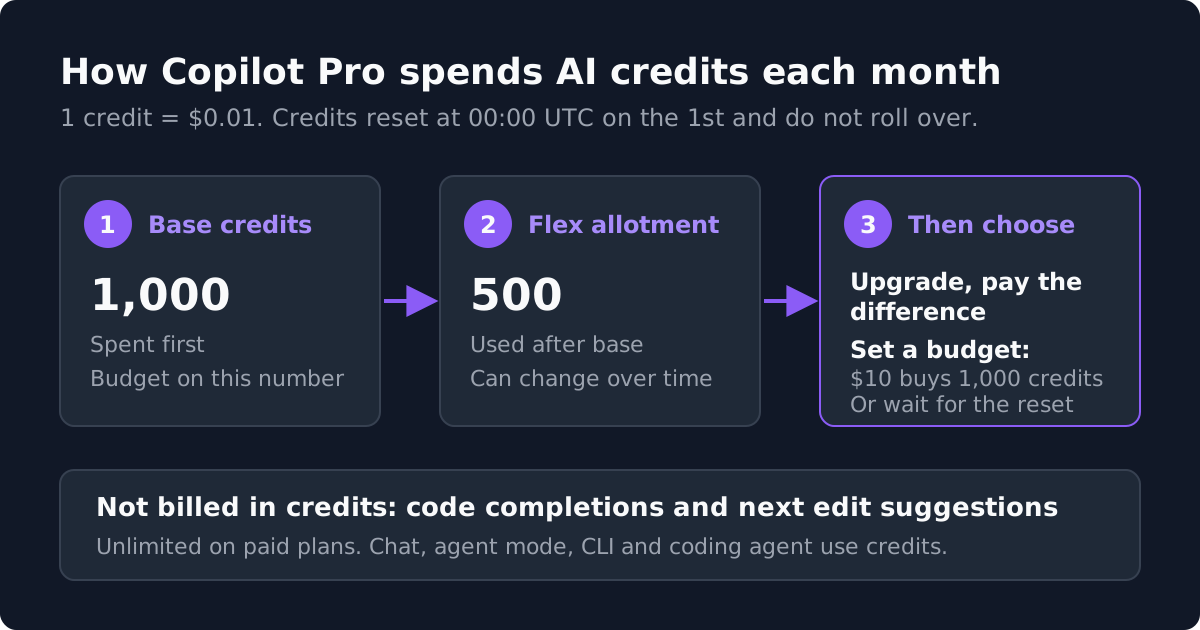
Two things in that table are easy to miss. The individual plans include a "flex allotment" on top of the base credits, and GitHub says the flex portion is designed to adapt as the economics of AI change, which means it can go down. Budget on the base number. And the organization plans have no flex portion at all: a Business seat gets exactly $19 of credits for its $19.
How AI Credits Replaced Premium Requests
If you last looked at Copilot pricing in early 2026, you remember premium requests: a monthly count of requests to the better models, with a per-request overage charge. That system ended on June 1, 2026, when every Copilot plan moved to usage-based billing in GitHub AI Credits. There is no longer a per-request price to quote.
What costs credits. Anything that calls a model: Copilot Chat, agent mode, the Copilot CLI, the cloud coding agent, Copilot Spaces, Spark and third-party coding agents. The charge depends on the model and the tokens consumed, including input, output and cached tokens. A long agent session on a frontier model burns far more than a quick chat question on a small one. GitHub publishes per-model rates per million tokens on its models and pricing page.
What does not. Code completions and next edit suggestions are not billed in credits and stay unlimited on every paid plan. If most of what you use Copilot for is tab completion in the editor, Pro is effectively unlimited for you.
Reset and rollover. Credits reset at 00:00 UTC on the first day of each calendar month, regardless of when your billing cycle starts. Unused credits do not carry over. Base credits are spent first, then the flex allotment.
Code review also uses Actions minutes. Since June 1, 2026, Copilot code review consumes GitHub Actions minutes in addition to AI credits. On a private repo with a tight Actions budget, that is a second meter to watch. Our GitHub Team pricing guide covers how many Actions minutes each GitHub plan includes.
This walkthrough explains how tokens become AI credits, what consumes them, and how agent mode and the coding agent differ under the new billing.
What Happens When You Run Out of Credits
On Pro, Pro+ and Max. You have three options. You can upgrade mid-month and pay only the price difference, and you get the higher plan's allowance minus what you have already used that month. You can stay on your plan and set a dollar budget for additional usage, billed at $0.01 per credit, so a $10 budget buys 1,000 more credits. Or you can wait for the reset on the first of the month. GitHub notes that additional usage on individual plans may be capped based on usage patterns, billing history and account verification, and you may need to pay off what you have used before continuing.
On Business and Enterprise. Credits are pooled across the billing entity, so 10 Business seats share a 19,000-credit pool and a light user's leftovers cover a heavy user. When the pool is empty, usage continues at the published per-credit rates if paid usage is allowed. That is the default. An admin has to disable the "AI credits paid usage" policy to block it, in which case usage stops until the monthly refresh. You can set user-level, cost-center and organization budgets, and a $0 user-level budget blocks that user immediately. There is no automatic fallback to a cheaper model when a budget runs out; requests simply stop.
Practical advice for a founder: set an organization budget the day you buy Business. With paid usage on by default and pooled credits, one engineer running agents on the most expensive model all week can turn a $190 bill into something you notice.
What Copilot Free Actually Gets You
Copilot Free costs nothing and needs no card. It includes 2,000 inline code completions per month and a limited chat and agent allowance. GitHub's billing docs describe that allowance in AI credits without publishing a number, while the FAQ on the plans page still says 50 chat requests a month including Copilot Edits. Either way, it is enough to evaluate Copilot over a few days, not enough to work with it full time.
The other limits matter more than the counts. Free users reach models only through auto model selection, so you cannot pick a specific model. The cloud coding agent, which takes an issue and opens a pull request, is not on Free, and neither is Copilot code review. You can buy extra credits on Pro, Pro+ and Max but not on Free, so when the allowance is gone you wait for the next month or upgrade. Free does include agent mode in the editor, the Copilot CLI and MCP server support.
One more thing to know: GitHub's plans page states that interactions from Free, Pro and Pro+ users may be used to train its models unless the user opts out. Check that setting if you are working in company code on a personal plan.
Pro vs Pro+ vs Max: Which Individual Plan
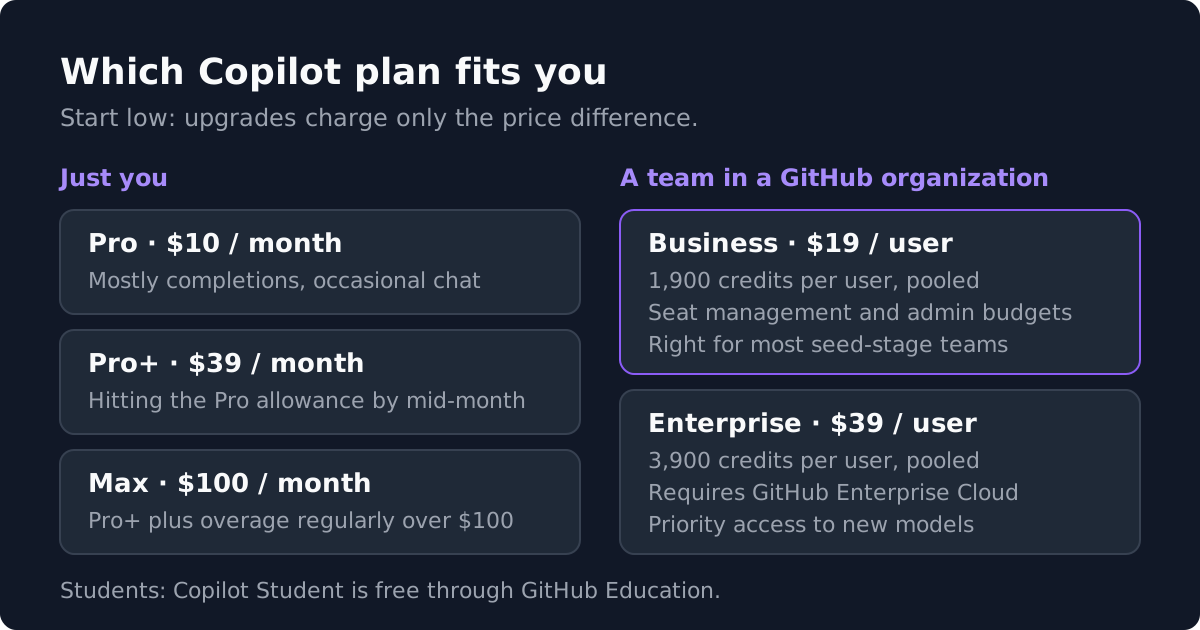
Copilot Pro ($10). Unlimited completions, the full model catalog, agent mode, the cloud coding agent and code review, with 1,500 credits a month. GitHub positions it for individual developers, freelancers, students, educators and open source maintainers. If you mostly use completions and occasional chat, this is the plan.
Copilot Pro+ ($39). Nearly five times the credits of Pro for four times the price, plus delegation to third-party agents such as Claude and OpenAI Codex, which GitHub lists as a preview feature. This is for developers who use agent mode or the cloud agent several times a day and keep hitting the Pro allowance by mid-month.
Copilot Max ($100). 20,000 credits and higher spending limits. GitHub added it on June 1, 2026, initially as an upgrade for existing subscribers, and opened new sign-ups from June 17. It competes directly with the $100 tiers from Anthropic and Cursor. Only worth it if your monthly usage on Pro+ plus overage regularly passes $100.
The rule of thumb: start on Pro, watch the usage page for a month, and move up only when the overage you are paying exceeds the price gap. Because upgrades charge just the difference, there is no penalty for starting low.
Individual vs Business vs Enterprise for a Startup Team
A two-person founding team can get away with each founder paying for Pro. Past that, the organization plans earn their price for reasons that have little to do with the AI itself.
Copilot Business ($19 per user). Bought by a GitHub organization and assigned per seat. It adds what the individual plans lack: centralized seat management, organization-wide policies over models and preview features, and credits pooled across the organization with admin spending controls. Seats can be added or removed at any time; added seats are prorated, removed seats bill until the end of the cycle. For a five-engineer team that is $95 a month, or $1,140 a year, before any overage.
Copilot Enterprise ($39 per user). Twice the credits of Business per seat, priority access to new models and features, and a hard requirement: you must be on GitHub Enterprise Cloud. That makes it a decision about your whole GitHub plan, not just Copilot. Most seed-stage teams on GitHub Team are better served by Business until they need Enterprise Cloud for compliance reasons.
The pooled credit model changes the math compared with individual plans. On Pro, a heavy user's overage is theirs alone. On Business, light users subsidize heavy users from the same pool, which usually means fewer overage charges for the same team. The trade-off is that Business seats do not include the flex allotment that individual plans get. If your team is still deciding how much of GitHub it needs at all, our GitHub Pro pricing and GitHub Team pricing guides cover the base plans that Copilot sits on top of.
Copilot vs Cursor vs Claude Code on Cost
Copilot is among the cheapest ways to put AI in every engineer's editor. Pro is $10 with unlimited completions, and Business at $19 a user sits below Cursor Teams and Claude Team Premium seats. Where the tools differ is in how much agent usage each dollar buys, and that depends on how your team works.
Cursor. As of October 2026, cursor.com lists individual plans from $8 to $200 a month and Teams from $30 per user per month, with usage scaling by tier. Cursor is a full editor rather than an extension, so the comparison is partly about whether your team wants to switch IDEs. Our Cursor pricing page breaks down each tier.
Claude Code. Claude Code is included in Claude Pro at $20 a month ($17 billed annually) and in Max from $100 a month, and in Team Premium seats at $125 a month ($100 billed annually). It is terminal and agent first, with no inline completions in the Copilot sense. Many teams run both: Copilot for completions in the editor, Claude Code for longer agent tasks. Our Claude Code pricing guide covers the plan and API options.
| Tool | Individual price | Team price | Form factor |
|---|---|---|---|
| GitHub Copilot | $10 Pro, $39 Pro+, $100 Max | $19 / user (Business) | Extension in your editor, unlimited completions |
| Cursor | $8 to $200 / month | From $30 / user | Full editor, usage scales by tier |
| Claude Code | $20 Claude Pro ($17 annual), Max from $100 | $125 Team Premium seat ($100 annual) | Terminal and agent first, no inline completions |
Copilot also gives you several vendors' models under one bill. The plans page lists Anthropic Claude, OpenAI GPT, Google Gemini, xAI Grok and other models, with the same catalog across paid individual plans, so you are not locked into one lab's roadmap.
How to Get GitHub Copilot Free or Discounted
Beyond Copilot Free, there are four legitimate ways to pay less than list price.
GitHub for Startups. This is the big one for companies. Eligible startups receive $10,000 in GitHub credits, valid for up to 12 months from approval, usable on GitHub Enterprise license costs and eligible add-ons including GitHub Copilot, plus Advanced Security and Actions. At Copilot Enterprise list price that covers a lot of seat-months. To qualify you must be affiliated with a GitHub for Startups partner (a participating VC, accelerator or incubator), have raised outside equity funding up to Series B, not have been on a GitHub Enterprise plan in the past six months, and not have received GitHub credits or Enterprise licenses before. Credits apply to GitHub Enterprise Cloud on GitHub.com only, not Enterprise Server or Data Residency, and the offer can be redeemed once. When the credits run out, products move to standard paid billing on your card. Eligibility details and how to apply are on our GitHub for Startups page.
Students. Verified students get Copilot Student free through GitHub Education. It includes unlimited completions and an AI credit allowance, with models via auto selection and no third-party agents. It comes with the rest of the GitHub Student Developer Pack, and it ends when GitHub can no longer verify your student status.
Teachers. Verified teachers may be eligible for free access to Copilot Pro, also through GitHub Education.
Open source maintainers. GitHub says maintainers of popular open source projects may be eligible for free Copilot Pro.
What does not exist: Copilot coupon codes, lifetime deals, or resold seats. Shared or resold accounts violate GitHub's terms.
Frequently Asked Questions
How much does GitHub Copilot cost?
As of October 2026, Copilot Free is $0, Pro is $10 a month, Pro+ is $39, Max is $100, Business is $19 per user per month and Enterprise is $39 per user per month. Each paid plan includes a monthly allowance of AI credits worth $0.01 each, and extra usage is billed at the same rate.
Is GitHub Copilot free?
There is a free plan with 2,000 completions a month and a limited chat and agent allowance. Verified students get Copilot Student free, and verified teachers and maintainers of popular open source projects may get Copilot Pro free. Startups affiliated with a GitHub for Startups partner can cover Copilot with $10,000 in GitHub credits.
What happened to Copilot premium requests?
They were replaced on June 1, 2026, when all Copilot plans moved to usage-based billing in GitHub AI Credits. Usage is now charged by model and tokens rather than per request, and code completions are not metered at all on paid plans.
What happens if I use up my Copilot credits?
On individual plans you can upgrade and pay the difference, set a budget for extra usage at $0.01 per credit, or wait for the reset on the first of the month. On Business and Enterprise, extra usage is allowed by default once the pooled credits run out, unless an admin turns off the paid usage policy.
What is the difference between Copilot Pro and Pro+?
Pro is $10 with 1,500 credits a month. Pro+ is $39 with 7,000 credits and adds delegation to third-party agents such as Claude and Codex, which is in preview. Both include unlimited completions and the cloud coding agent.
Does GitHub for Startups include Copilot?
Yes, indirectly. The program gives $10,000 in GitHub credits for up to 12 months that can be spent on GitHub Enterprise and eligible add-ons, including Copilot. You need to be affiliated with a GitHub for Startups partner and funded up to Series B. See our GitHub for Startups page for the full requirements.
Next Steps
If you are a solo developer, start on Copilot Free for a week, then move to Pro and watch your credit usage for a month before going higher. If you are a team, check whether one of your investors or your accelerator is a GitHub for Startups partner before buying any seats; $10,000 in credits goes a long way toward Copilot and Enterprise Cloud seats for a small team. Our GitHub for Startups page keeps the eligibility rules current, and the Cursor and Claude Code pricing pages help if you are weighing alternatives.
