

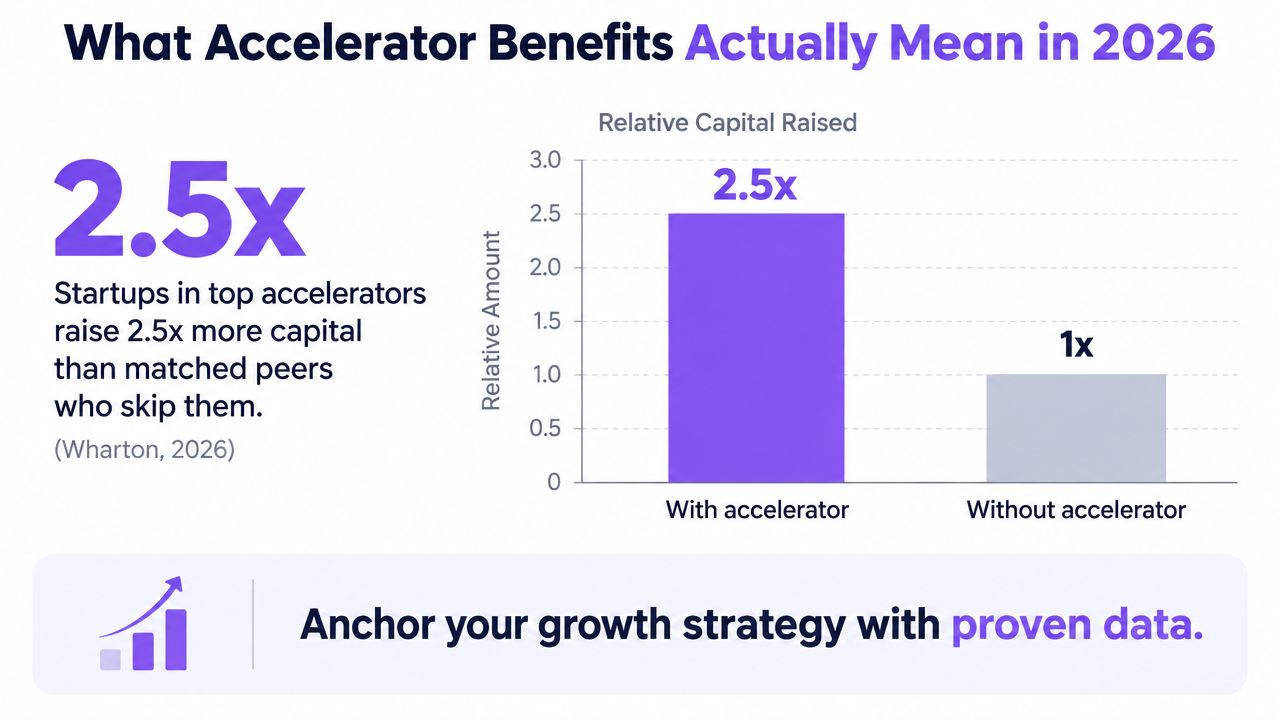
The most important accelerator benefit isn't the demo day check. It's what happens afterward. A 2024 Wharton study analyzing 8,580 startups across 408 accelerators in 176 countries found that accelerated startups were 3.4% more likely to raise venture capital than comparable peers. They also raised $1.8 million more in the first year after graduation and planned to raise $2.64 million more over the following year.
That result makes accelerator participation worth examining seriously, but not accepting blindly. Founders give up equity, time, focus, and often some control over fundraising timing. The right question isn't whether a program advertises funding, mentorship, perks, and connections. It's whether those benefits produce measurable value that remains after the cohort ends.
What Accelerator Benefits Actually Mean in 2026
An accelerator benefit is real only when a founder can connect it to a business outcome. A mentor who appears on a website but never replies isn't meaningful support. A large software-credit figure that the company never activates isn't runway. A crowded demo day that produces no qualified investor conversations is exposure, not traction.
The Wharton evidence provides a useful starting point. Accelerated startups in the study performed better on several operating and financing measures, including venture funding, revenue, full-time hiring, and wages, with the financing results showing that the value of a strong program can extend beyond its scheduled curriculum. Those findings don't mean every accelerator creates the same result. They mean program quality and founder fit deserve more attention than generic benefit lists receive.
A practical evaluation starts with a working ledger:
- What the founder gives up: Equity, attention, operating flexibility, and the ability to pursue fundraising on an entirely independent schedule.
- What the program promises: Capital, services, mentoring, introductions, credibility, and structured accountability.
- What the founder must verify: Follow-on funding, useful pilots, retained customers, active advisors, and investor relationships that still exist after graduation.
The measurement window matters. A founder should review outcomes well after demo day, asking whether the company closed funding, improved its metrics, signed customers, and retained useful relationships. The startup accelerator explainer provides useful baseline context, but a founder's decision should rest on the specific program's evidence and terms.
Practical rule: Treat every accelerator benefit as an investment claim until the program can show how founders received and used it.
The strongest programs help compress learning, financing, and relationship-building into a concentrated period. Weak programs create activity without progress. That distinction drives every decision that follows.
How Accelerators Fit Among Other Founder Resources
An accelerator is a structured, cohort-based, time-boxed program designed to move early-stage companies through an intensive period of development and fundraising preparation. Programs commonly include a curriculum, office hours, peer sessions, investor preparation, and a closing demo day. In exchange, the program generally receives equity or an equity-linked instrument.
That structure separates an accelerator from several resources founders often group together.
| Resource | Structure | Equity | Typical Check | Primary Benefit |
|---|---|---|---|---|
| Accelerator | Cohort-based and time-boxed | Usually required | Program-dependent | Capital, structured guidance, and investor access |
| Incubator | Longer-term and less standardized | Often equity-light or grant-based | Program-dependent | Workspace, community, and gradual company building |
| Grant | Application-based funding | Non-dilutive | Grant-dependent | Cash without ownership transfer |
| Venture capital | Investment relationship without a cohort curriculum | Required | Larger institutional investment | Capital and investor partnership |
| Angel syndicate | Investors combine or coordinate around a deal | Required | Individual investor dependent | Capital and selected introductions |
The distinction changes how founders assess value. Someone treating an accelerator like a grant may underestimate dilution and overlook the obligations attached to the deal. Someone treating a grant like an accelerator may expect weekly mentoring, investor preparation, or a founder community that the grant never promised.
Incubators can suit companies that need time, facilities, or a slower development environment. Grants make sense when a company can meet eligibility requirements and wants to preserve ownership. Venture capital may be more appropriate once the company has enough traction for a direct institutional relationship. Angel syndicates can provide useful financing without a formal curriculum, although the quality of involvement varies by investor.
Founders comparing these paths can use this startup founder resources guide to map each option against capital needs, ownership goals, and the kind of operational support the company requires.
The category isn't the strategy. The resource is valuable only when its structure matches the company's next constraint. A founder who needs customer discovery may benefit from hands-on operating help. A founder who already has a strong investor pipeline may need non-dilutive cash or targeted technical support instead.
The Five Core Accelerator Benefits Founders Receive
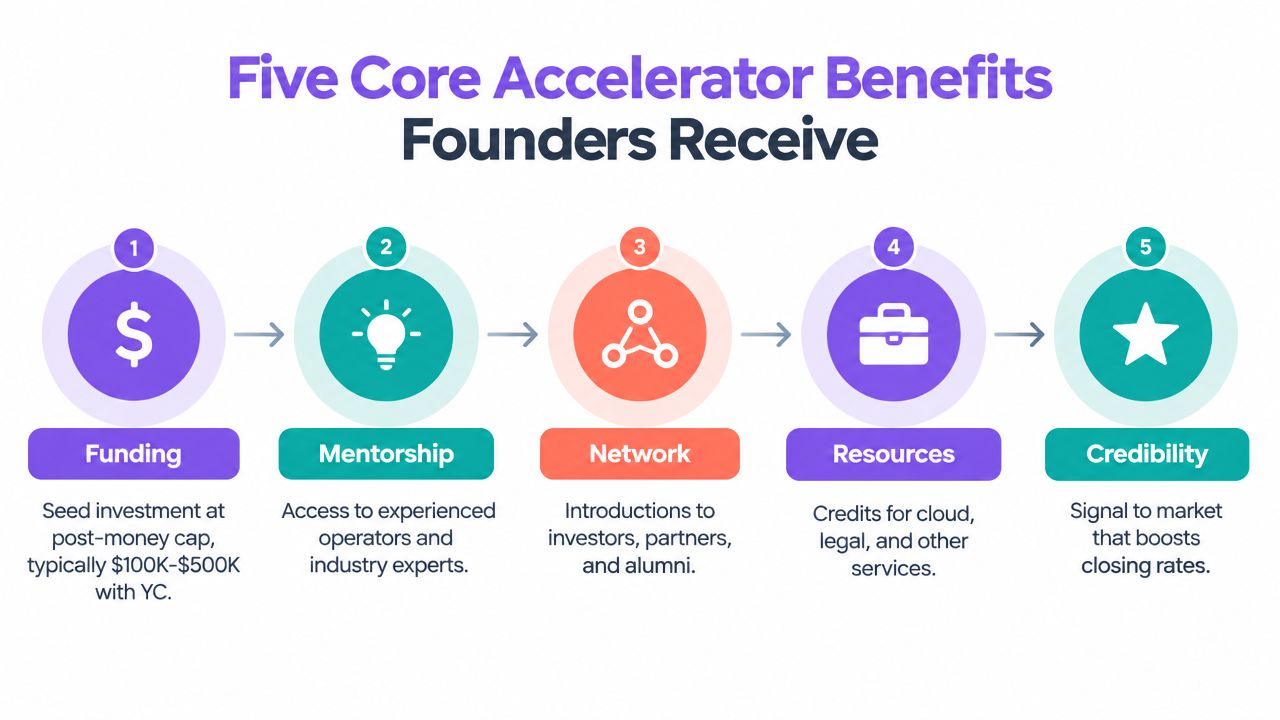
Accelerators usually sell five benefits, but each one has a different test for value. Capital is easy to count. Mentorship, network access, and credibility require evidence of use and conversion.
Funding
The initial investment can extend runway and give a company enough time to build a product, test distribution, or reach a stronger financing milestone. Founders should evaluate the money alongside the instrument, valuation mechanics, pro-rata rights, and timing of the investment. Cash isn't automatically attractive if the company gives up disproportionate ownership or accepts terms that complicate the next round.
The more important funding question is whether the program improves access to later capital. An initial check helps only temporarily. A strong program should also make qualified investor conversations easier and help founders prepare for those conversations with credible metrics and a clear financing narrative.
Credits and perks
Credits for infrastructure, software, legal services, payments, and business operations can reduce cash burn. Their advertised list value matters less than the amount the startup will consume before expiration, along with eligibility rules and renewal conditions.
A founder should create a simple usage forecast. If the company won't use a benefit, it shouldn't count that benefit as part of the deal's value. The startup perks directory can help founders identify non-dilutive alternatives and compare usable offers before assigning value to an accelerator package.
Mentorship
Mentorship works when the advisor has relevant operating experience, understands the company's stage, and remains available for specific decisions. A long mentor roster proves very little. The useful questions are practical: Who attends office hours? How often can founders speak with them? Do mentors make introductions? Can alumni describe a decision that changed because of the relationship?
Network
A network should produce targeted access, not a contact spreadsheet. Warm introductions to suitable investors, customers, partners, or future hires can save time, but only when the program understands the company's market and has relationships that match it. Elite programs tend to separate themselves from generic cohorts.
Demo day and credibility
Demo day concentrates attention, but the presentation is only the beginning. Founders need a clear follow-up process, fast qualification, and a landing experience that turns temporary interest into meetings. Teams preparing for that surge can use this demo day traffic spike guide to plan for visitor volume and follow-up without confusing attention with demand.
A demo day also creates a signal. Investors may use program affiliation as an initial filter, but the signal won't replace product evidence, customer insight, or disciplined execution.
The five benefits work together only when the program converts them into progress. Funding without guidance can extend weak execution. Mentorship without access can become commentary. Exposure without a follow-up system can disappear within days.
Funding Outcomes After the Program Ends
The strongest financing case for an accelerator appears after graduation. A 2026 NBER working paper found that non-accelerated startups averaged $0.20 million in post-accelerator funding, and only 8% ever received venture financing. Accelerated startups raised $0.53 million more in post-accelerator funding on average and were 29 percentage points more likely to receive any lifetime funding.
The corporate-affiliated program result was larger. Accelerated startups in that comparison raised $1.27 million more and were 36 percentage points more likely to receive funding. The finding supports a critical point: a good accelerator can alter a company's long-run capital trajectory, not merely provide a short-term check.
| Metric | Accelerator Alumni | Non-Accelerated Peers |
|---|---|---|
| Average post-program funding | $0.53 million more on average | $0.20 million average |
| Lifetime venture financing | 29 percentage points more likely | 8% ever received venture financing |
| Corporate-affiliated program difference | $1.27 million more | Comparison group |
The financing advantage can come from two sources. The first is signal-driven. A recognized program gives investors a reason to take an initial meeting and may reduce uncertainty about the team. The second is skill-driven. A demanding program can improve positioning, metrics, customer discovery, and fundraising execution.
Those sources matter differently. Signal helps a founder reach investors faster, but it fades if the company can't demonstrate progress. Skill compounds because better customer conversations, sharper reporting, and clearer fundraising materials remain useful after the cohort.
Founders should therefore judge the post-program outcome, not just the graduation check. The startup funding report can support broader funding research, but each accelerator should still provide its own alumni data and definitions. A program that won't explain how it measures follow-on funding isn't giving founders enough information to price its financing benefit.
Why Most Accelerators Underperform and Few Stand Out
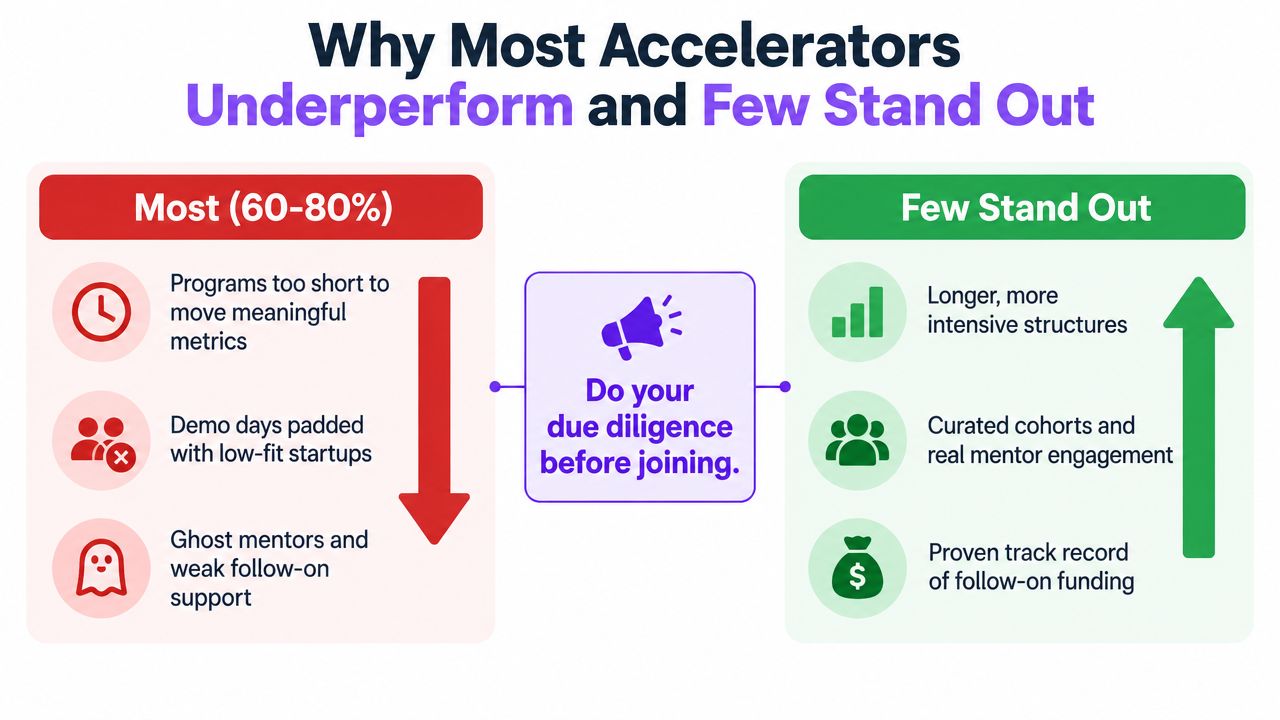
The uncomfortable evidence is substantial. A 2026 NBER study analyzing nearly 750,000 U.S. startups across 329 accelerators found that about 60% to 80% of programs produced worse outcomes than no accelerator at all. Only a small elite group materially improved funding, acquisitions, revenue, and employment growth.
That finding destroys the universal-benefit narrative. An accelerator isn't automatically helpful because it has a curriculum, a mentor directory, or a final pitch event. Some programs consume the founder's most valuable working hours while delivering little that the company couldn't obtain elsewhere.
Why the long tail disappoints
Weak programs often share predictable flaws:
- Poor stage discipline: They accept companies with incompatible needs, so early discovery teams sit beside companies preparing for institutional fundraising.
- Low-fit investor access: Demo days may create a large audience without producing conversations with investors who understand the sector or stage.
- Inactive mentors: The program lists respected names, but founders rarely receive sustained access or practical feedback.
- Thin follow-on support: Staff celebrate graduation and then stop helping with the next financing, hiring challenge, or customer introduction.
- Activity over outcomes: Mandatory sessions create a busy calendar without improving the metrics that investors and customers evaluate.
What elite programs do differently
A small group stands out through selection discipline, engaged mentors, strong alumni participation, and evidence that graduates continue raising capital or building durable companies. Sector-specific programs can be especially useful when their partners understand regulatory, technical, procurement, or distribution barriers that generalist mentors don't.
A prestigious logo is a starting signal, not proof that the program fits a particular company.
Founders should demand outcome evidence by cohort and stage. The relevant comparison isn't the program's best-known graduate. It's the typical company that resembles the applicant.
The Equity Tradeoff Behind Every Accelerator Deal
The most commonly cited accelerator terms cluster around 5% to 10% equity, according to independent 2026 coverage of accelerator equity terms. That same coverage identifies Y Combinator at 7% for $500,000 and Techstars at roughly 5% to 6% for smaller checks.
| Program | Typical Equity Ask | Standard Investment | Estimated Total Benefit Value |
|---|---|---|---|
| Y Combinator | 7% | $500,000 | Depends on capital, access, and actual usage |
| Techstars | About 5% to 6% | Smaller check | Depends on capital, access, and actual usage |
| Niche or non-equity program | Program-specific | Program-specific | Must be verified from terms and usage |
The table isn't a recommendation. It shows why the equity percentage can't be evaluated without the complete agreement. A founder should review the SAFE or other instrument, conversion mechanics, pro-rata rights, information rights, and any additional ownership provisions. The SAFE versus convertible note guide can help clarify the distinction before legal review.
The value calculation is straightforward. Suppose a founder estimates the company's current post-money value, then applies the accelerator's equity ask. That figure represents the ownership cost at today's negotiated value, not a guaranteed future payout. The program must then deliver enough usable capital, credits, introductions, signal, and operating improvement to justify that cost.
A 7% stake isn't expensive or cheap. It could be attractive if the program materially improves the next financing outcome and supplies access the founder can't buy independently. It can be a poor deal when the cash is modest, the credits are unusable, the mentors are inaccessible, and the investor network doesn't convert.
A 2025 meta-analysis found a statistically significant positive effect on venture performance overall, but the effect size was modest at r = 0.102, as reported in the same independent coverage. The implication is blunt: the average accelerator benefit may exist without being large enough to justify the equity in every case.
How to Evaluate an Accelerator Before You Apply
A founder shouldn't submit an application until the program survives a practical filter. The application process should be two-sided. The program evaluates the company, while the company evaluates the program's ability to create value.
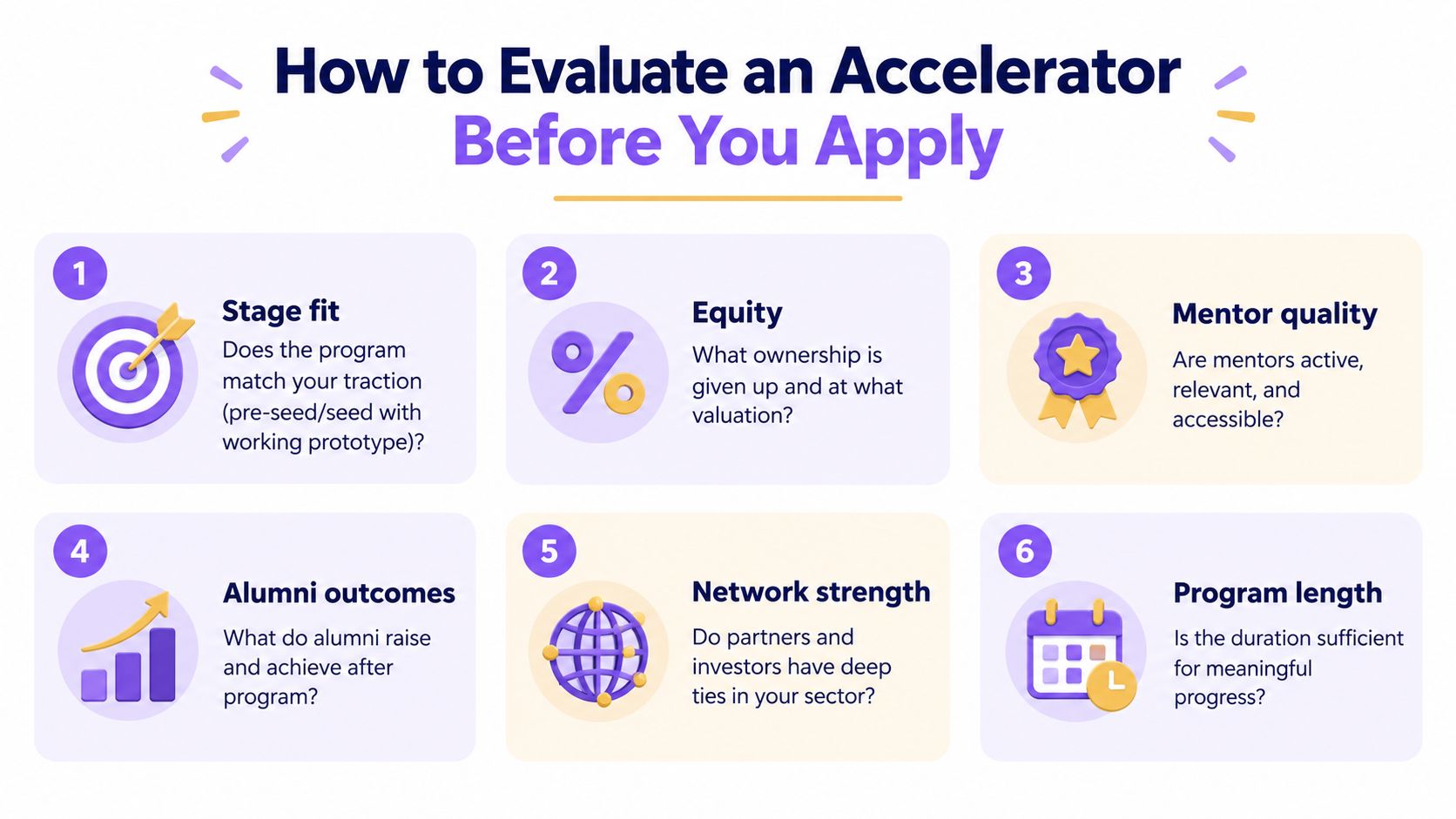
- Stage fit: Confirm that the cohort matches the company's maturity, product state, sector, and fundraising objective. A program built for working prototypes and early revenue won't necessarily help a company still searching for a problem.
- Equity terms: Request the complete documents. Review the ownership percentage, valuation language, SAFE provisions, MFN clauses, and pro-rata rights with counsel.
- Perk usability: List the services the company will use, then calculate usable value rather than accepting inflated list prices. Expiration dates, restrictions, and eligibility can reduce practical value sharply.
- Mentor quality: Ask for names, availability, relevant operating backgrounds, and examples of ongoing alumni access. A logo-heavy advisor page isn't enough.
- Alumni outcomes: Request verified follow-on funding, acquisitions, revenue progress, employment growth, and survival information. Ask how the program defines and measures each outcome.
- Cohort composition: Review prior batches. A company needs peers and partners that understand its market, not merely a large group of unrelated founders.
Warning signs deserve a direct response:
- Missing terms sheet: A serious applicant shouldn't have to guess what ownership the program receives.
- Refusal to share alumni data: Confidentiality can limit detail, but total opacity prevents rational evaluation.
- Vague demo day claims: The program should explain the investor audience and follow-up process.
- Unclear post-graduation support: Founders should know whether introductions, office hours, and community access continue.
These questions belong in an email to the program manager before applying. Detailed answers demonstrate operational maturity. Evasive answers are data.
Deciding Whether an Accelerator Is Worth It for You
The decision comes down to a simple comparison. Estimate the ownership cost using the company's realistic post-money value and the accelerator's equity ask. Then compare that cost with the usable value of funding, credits, introductions, mentoring, credibility, and the probability-weighted improvement in future financing.
A founder with product-market fit, strong investor access, and alternative sources of credits has a high bar to clear. The same founder may gain more by buying targeted services or securing non-dilutive support. Credit for Startups can help teams compare available credits, perks, and non-dilutive funding before they count an accelerator's benefits as unique.
The softer test matters too. Some founders thrive under intense schedules, direct feedback, and peer pressure. Others lose momentum when a program replaces customer work with sessions and pitching. The right question isn't whether the founder likes the accelerator's brand. It's whether the program will improve the company's next operating milestone.
A grant can also solve a different problem without taking equity. Founders preparing a non-dilutive application may find a practical resource on writing a support letter for a grant, especially when partners or community organizations need to document their support clearly.
Take the accelerator if its specific benefits materially accelerate the company's next six months. Skip it if they don't.
Credit for Startups helps founders discover and compare startup credits, perks, accelerators, and non-dilutive funding without giving up equity for every resource. Visit Credit for Startups to identify usable offers, check eligibility, and reduce the cost of building the company before signing an accelerator deal.
