


The most popular incorporation advice is also the least useful: “File the formation documents, then you're done.” A certificate creates the legal entity, but it doesn't automatically let the company invoice customers, hire staff, open a bank account, satisfy ownership disclosures, or obtain industry approvals.
Founders should treat incorporation as a sequencing problem. The central question isn't only which jurisdiction accepts the filing. It's which filing enables the next operational step, which information must match across documents, and which supposedly optional registration can delay the first payment.
What Incorporation Really Requires in 2026
Incorporation has become faster and less expensive in many economies, but the surrounding compliance work hasn't disappeared. World Bank business-registration indicators show that starting a business averaged 20 days and cost 23% of income per capita in 2019, compared with 47 days and 76% of income per capita in 2006. Average paid-in minimum capital requirements had also fallen to 6% of income per capita, illustrating how formation requirements became materially lighter over that period. World Bank business-registration indicators
That progress changes the founder's risk. The filing itself may be straightforward, while the operational stack remains fragmented across tax agencies, employment authorities, banks, licensing bodies, and ownership-reporting systems. A company can be legally formed and still be unable to collect revenue or put someone on payroll.
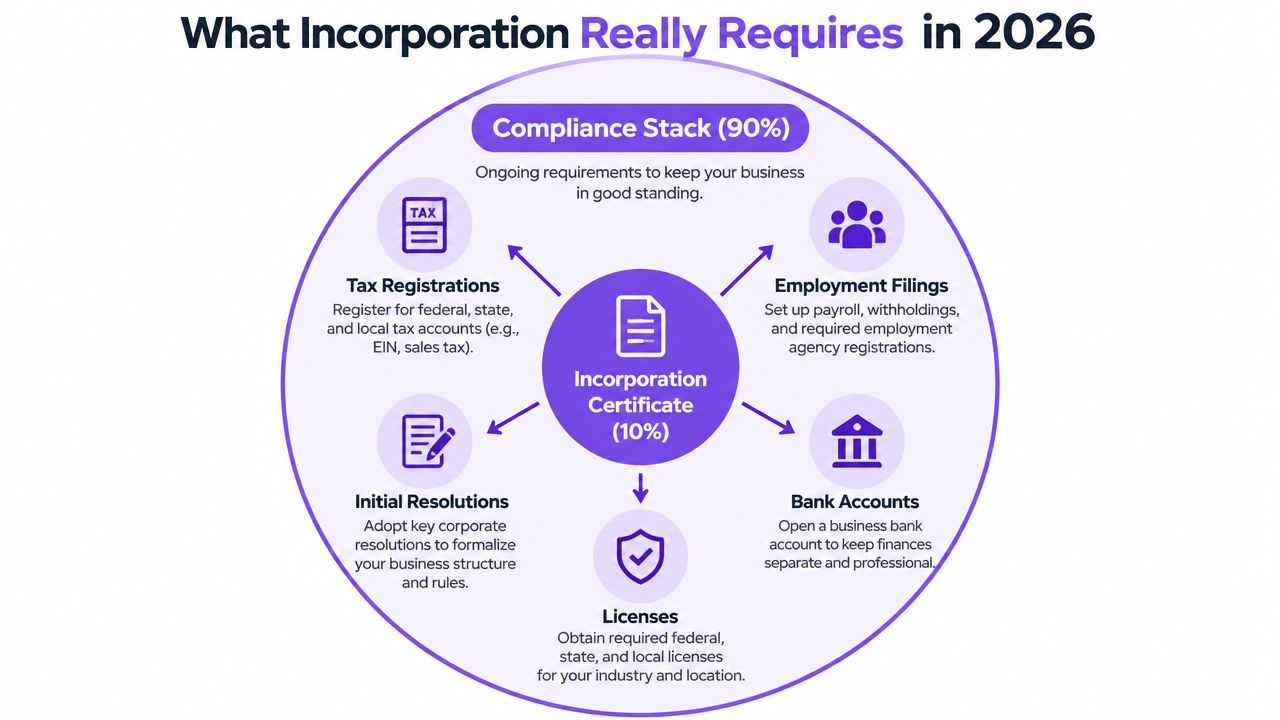
The certificate is only one milestone
A practical incorporation file usually contains:
- Formation documents, including the charter, certificate, or formation statement.
- Registered-agent and office arrangements, so legal notices can be received.
- Ownership and control information, prepared consistently with the cap table.
- Internal governance documents, including bylaws, operating agreements, and initial resolutions.
- Tax and payroll registrations, completed before the company needs to invoice or hire.
- Licenses and sector approvals, where the business activity requires them.
- Recurring filings, such as annual reports, tax returns, and entity-level payments.
Founders comparing entity choices can use this incorporation overview from Credit for Startups as a starting point, then confirm the actual rules for the chosen jurisdiction. A broader practical guide from David J. Greiner Law Corp on incorporation can also help clarify the difference between the initial filing and the obligations that follow.
Practical rule: The first operating deadline should determine the filing sequence, not the other way around.
Core Formation Documents You Must Prepare
The filing creates the entity, but the document set makes it usable. Prepare four connected groups, and sequence them around the first real operating need, such as issuing founder equity, opening a bank account, hiring, or signing contracts. Delaware is a useful reference point because its formation rules are defined in statute. A corporation begins by filing a certificate of incorporation with the Division of Corporations. The filing identifies the entity name, registered office, registered agent, business purpose, and incorporator. See the Delaware corporation formation requirements.
The charter-level filing
The certificate of incorporation creates the corporation under state law. It must support the intended share structure, including authorized shares and any relevant classes or rights. Check the registered-agent and incorporator details before filing. Financing records, ownership documents, and later compliance filings will rely on this foundation.
For an LLC, Delaware uses a certificate of formation. The LLC's formation becomes effective upon filing, and the entity must maintain a Delaware registered agent.
Internal governance rules
Bylaws generally stay with the company rather than the state filing. They define director appointments, officer authority, meetings, written consents, and approval procedures for significant transactions.
An LLC usually relies on an operating agreement. It should match the actual ownership arrangement, management structure, voting rights, transfer restrictions, and distribution mechanics. A generic template is a poor fit where the deal includes multiple equity classes, vesting, or investor consent rights.
Organizational consent actions
The initial board or member consent supplies the approvals that let the new entity operate. It typically adopts the bylaws or operating agreement, appoints officers, approves the bank relationship, authorizes founder equity issuance, and confirms accounting and tax arrangements.
If the company may qualify for small-business stock treatment, address the relevant election during this organizational stage. Reconstructing the decision later is harder and may leave gaps in the records.
Founder-level paperwork
Founder agreements should cover equity vesting, confidentiality, invention assignment, restricted-stock purchase terms, and transfer of intellectual property to the company. A founder receiving restricted stock should assess an 83(b) election immediately. The election must be filed within 30 days of the relevant stock transfer, and missing that deadline can create a significant tax problem.
Founders seeking a guided workflow can review Stripe Atlas incorporation resources. Use any guided package as an administrative starting point, then revise the governing documents to reflect the actual founder arrangement, equity terms, and approval record.
Registered Agent and Registered Office Rules
Registered-agent details are part of the operating sequence, not filing decoration. The certificate creates the entity, but the agent and office keep legal notices moving so the company can invoice, hire, and maintain a bank relationship without missing a formal obligation. Treat the address as a control point in the compliance system.
A registered agent accepts service of process, receives government correspondence, forwards compliance notices, and follows formal procedures when the company changes providers. A missed notice caused by an outdated address or failed forwarding process can create a larger problem than the annual service fee, including missed deadlines or damage to the company's standing.
Delaware requires every business entity to maintain a registered agent with a physical street address in Delaware. A post-office box does not satisfy that requirement. The agent must be available to receive documents, while the registered office and agent information must remain current. Review the Delaware registered-agent and entity requirements before filing.
The UK uses the registered-office concept rather than Delaware terminology. The office must be located in the same country within the UK as the company's registration and must be suitable for service and official correspondence. Choose the registration jurisdiction with the address requirement in mind. The UK incorporation and registered-office rules set out the relevant framework.
| Requirement | Delaware, U.S. | United Kingdom |
|---|---|---|
| Address type | Physical street address in Delaware | Physical registered office in the relevant UK country |
| Primary function | Receive service of process and official notices | Receive service and government correspondence |
| Founder's practical duty | Keep agent and office details current | Match the registered office to the registration jurisdiction |
| Main risk | Missed notices or loss of good standing | Invalid or unreliable service address |
A commercial agent can suit a remote founder, but select the service for dependable document handling, timely forwarding, and clear change procedures. A home address may work where permitted. It can also expose personal information and make legal service less private. Confirm who checks incoming documents, how quickly they are forwarded, and who updates the public record when the address changes.
Filing Fees, Franchise Taxes, and Hidden Costs
The certificate of incorporation is only the first bill. Plan four separate cost buckets: formation filing, registered-agent service, annual reporting, and entity-level taxes. Foreign qualification, certified records, and apostilles can add more costs when the company operates outside its formation jurisdiction.
The final amount depends on the jurisdiction, entity type, capitalization method, filing speed, and need for records used in banking or cross-border work. Get a written cost schedule before filing. It should list recurring obligations and the date each payment becomes due.
| Fee Category | Typical Range, USD | Recurring? | Common Surprise? |
|---|---|---|---|
| Formation filing | Varies by jurisdiction and entity | No | Expedited processing or certified copies |
| Registered-agent service | Varies by jurisdiction and provider | Often yes | Renewal charges and address-change fees |
| Annual report | Varies by jurisdiction and entity | Often yes | A separate filing may be required even when no business activity occurred |
| Franchise or entity tax | Depends on entity and jurisdiction | Often yes | The amount may depend on capitalization or entity classification |
| Foreign qualification | Varies by additional jurisdiction | Often yes | Local reports and taxes can apply after registration |
| Certified records or apostilles | Varies by document and destination | No | Banks or foreign authorities may demand formal copies |
Delaware LLCs generally owe a $300 annual tax, while corporations follow separate franchise-tax rules. Confirm the applicable obligation before choosing an LLC solely because its initial filing appears inexpensive. A low formation price does not make the structure low-cost.
Foreign qualification creates another recurring compliance layer. A Delaware company operating in another state may need local registration, a second compliance relationship, and additional reports. Compare the company's full administrative footprint before filing, rather than judging the jurisdiction by its online filing charge.
Budget for compliance after formation. The company may need records for a bank account, payroll setup, contracts, or cross-border transactions. Those requirements can turn a simple filing into a sequence of paid administrative tasks.
Tax-credit planning also belongs in the operating budget. Credit for Startups provides a resource on startup tax credits, which can help founders identify programs after the entity and tax records are properly established.
How Delaware, the UK, and Canada Differ
Incorporation is a sequencing problem, not a single filing. The certificate creates the entity, but the registered office, director records, ownership information, banking setup, hiring documents, and invoicing process determine whether the company can operate cleanly. Choose the jurisdiction around the founders' actual locations and operating plans, not mythology about “startup-friendly” places.
Delaware requires a Delaware registered agent and a physical registered office. Its formation rules do not state a general U.S.-residency requirement for shareholders or directors. The certificate must include specified formation information, and filing does not end the company's compliance work. Delaware LLCs generally owe the annual tax described earlier. Delaware entity requirements
The UK requires the applicant to choose England and Wales, Wales, Scotland, or Northern Ireland. The registered office must remain in the same country as the company's registration. Treat that choice as part of the formation plan, because changing the office later does not erase the original jurisdiction decision. UK incorporation requirements
Canada's federal process requires director information, including each director's first and last name, address, and resident-Canadian status. Federally, at least 25% of directors must be resident Canadians, or at least one must be resident Canadian where the board has fewer than four directors. That rule can shape the board before the founders submit the application.
| Rule | Delaware, U.S. | UK, Companies House | Canada, Federal |
|---|---|---|---|
| Registered-office location | Delaware physical street address | Same UK country as registration | Federal or applicable provincial address rules |
| Director or owner location | No general U.S.-residency requirement stated for formation | Structure must fit UK registration and office rules | Resident-director status affects federal formation |
| Information required | Entity and registered-agent details in certificate | Jurisdiction and registered-office details | Director names, addresses, and residency status |
| Main decision factor | State-law flexibility and ongoing maintenance | Country-specific office and public-record requirements | Director composition and federal structure |
Founders should also connect jurisdiction choice to fundraising plans. Review UK startup funding requirements and options alongside legal advice, then confirm that the planned entity, bank account, ownership records, and investor documents will work together. A jurisdiction that looks convenient at filing can create friction when the company invoices customers, hires staff, or raises capital.
Beneficial Ownership and Cap Table Disclosures
The cap table is no longer just an internal spreadsheet. It supplies information for beneficial-ownership reporting, and errors can spread when the equity ledger, constitutional documents, board consents, and regulatory filings disagree.
For U.S. reporting companies, FinCEN's beneficial-ownership framework identifies owners through two operational tests: direct or indirect ownership or control of at least 25% of ownership interests, or substantial control. Required company information includes the legal name, current address, jurisdiction of formation, and tax identifiers. Beneficial-owner information includes the person's full legal name, date of birth, address, and official identification number. Corporate Transparency Act and beneficial-ownership reporting overview
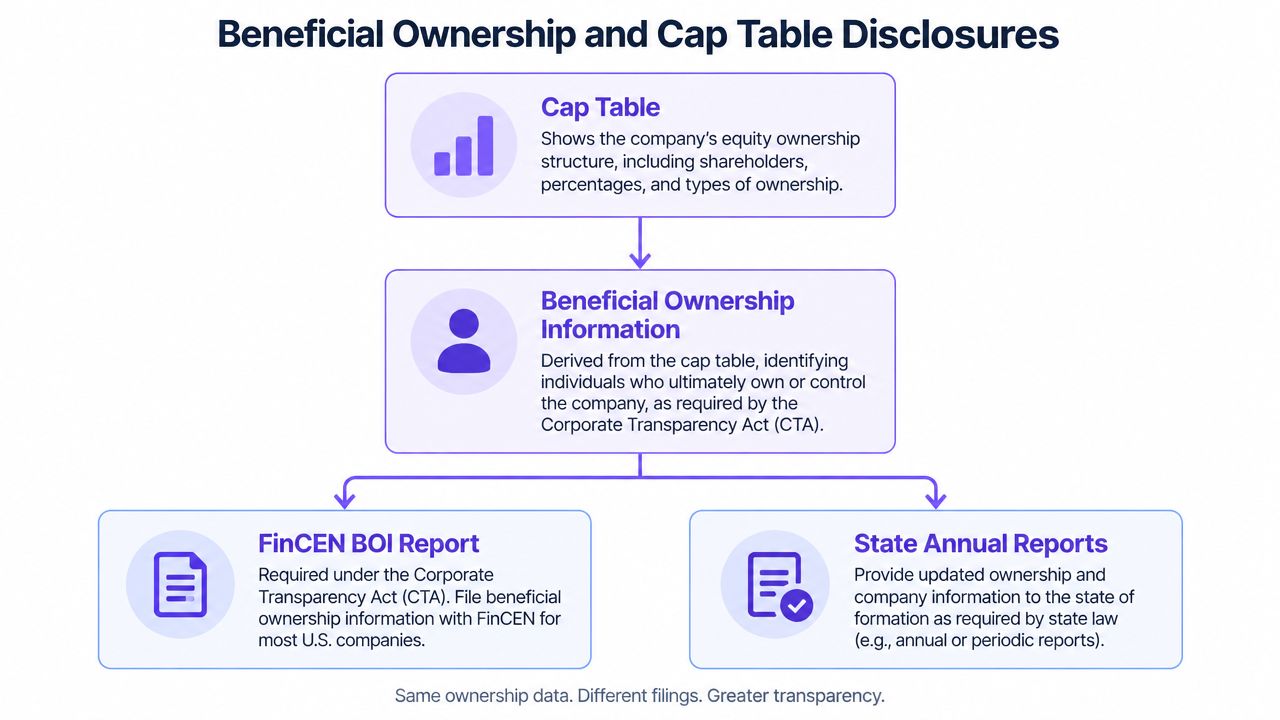
Prepare the ownership record before filing
The founder should finalize the initial cap table before submitting formation documents. That means identifying founders, entities, trusts, and anyone with practical control rights, then checking that the ownership percentages and voting arrangements match the planned issuance.
The company should also preserve the documents that explain control. Board appointment rights, veto rights, CEO authority, and special voting arrangements can matter even when no individual crosses an ownership threshold.
Keep every record synchronized
A clean process uses one controlled ownership record as the source for the stock ledger, subscription or purchase agreements, board consent, and beneficial-owner submission. A capitalization-management resource such as Carta for startup companies can help founders understand the recordkeeping problem, but legal review remains important where control rights or complex equity instruments are involved.
Ownership discipline: A cap table becomes a compliance document the moment the company's filings depend on it.
Typical Timelines From Filing to Operating
The certificate rarely causes the longest delay. Banking review, tax identification, payroll setup, and licensing usually determine when the company can do what the founders need.
The sequence has five practical stages:
- Formation approval. Delaware online filings can be processed on the filing day. UK Companies House processing can take 24 hours to 10 days, while Canadian online systems can take 1 to 3 business days, depending on the route used. These jurisdictional timing figures are drawn from the supplied incorporation guidance and should be confirmed at filing.
- Tax identification. U.S. tax-ID issuance can take 4 to 6 weeks by mail and under 24 hours online when the application meets the stated identity requirements. The timing should be checked directly with the relevant authority.
- Bank onboarding. A bank may complete account opening quickly or take substantially longer while reviewing identity, ownership, business activity, and source-of-funds information.
- Payroll registration. Payroll accounts generally require the tax identifier and accurate employer information before the first payment to an employee.
- Licensing and activation. A regulated product or service can remain blocked until the relevant approval arrives, regardless of when incorporation occurred.
| Stage | Delaware, U.S. | UK | Canada |
|---|---|---|---|
| Formation approval | Online filing can be same day | 24 hours to 10 days in the supplied guidance | 1 to 3 business days in the supplied guidance |
| Tax ID | Timing depends on application channel and identity eligibility | Depends on the relevant tax registration | Follows federal or provincial registration path |
| Bank account | KYC review can control the timetable | Ownership and identity checks apply | Director and ownership records must align |
| Payroll | Requires tax and employer setup | Requires local payroll registrations where applicable | Requires the relevant payroll account |
| Licensing | Activity-specific | Activity-specific | Activity-specific |
Founders should run parallel workstreams where possible, but they shouldn't treat parallel preparation as permission to skip dependencies. Ownership data, formation records, tax IDs, and licensing documents must be ready in the order the bank, payroll provider, or regulator needs them.
Post-Incorporation Registrations Founders Miss
The certificate is a milestone, not an operating company. In Canada, founders still need to build the registration stack that lets the business invoice, hire, import goods, and sell regulated products. Federal guidance covers the business number and related program accounts, while provincial and municipal rules add their own requirements. Canada incorporation and business-registration guidance
Use a trigger-based checklist. Tie each registration to the activity that creates the obligation.
- Business number: Obtain the federal identifier after incorporation when the applicable federal process requires it.
- GST/HST account: Register when the company's activities create the relevant tax obligation, before taxable invoicing begins.
- Payroll account: Open the applicable account before paying a founder or employee through payroll.
- Import/export account: Set it up before the first cross-border commercial shipment.
- Provincial tax accounts: Review requirements in every province where the company sells, hires, or operates.
- Workers' compensation: Confirm registration requirements before staff begin work in each province where they are employed.
- Business licenses: Secure municipal, provincial, and sector approvals before launching a regulated product or service.
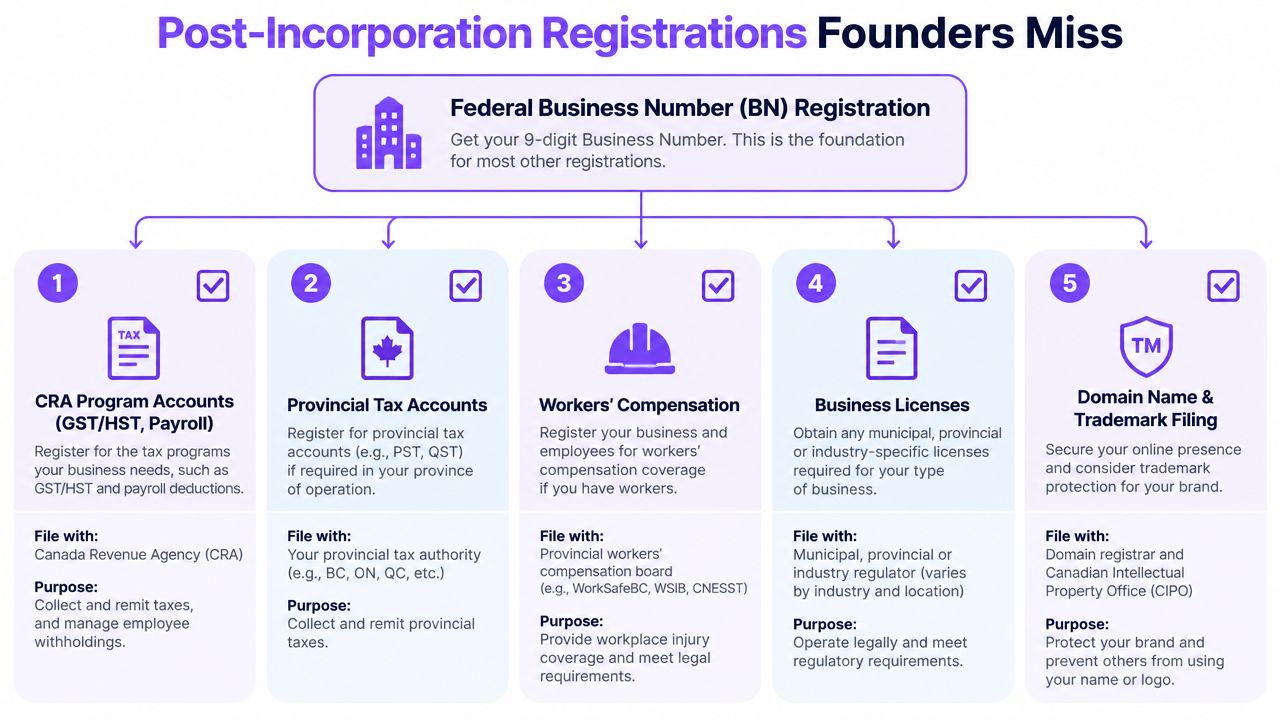
Do this review before launch, not after the first invoice, hire, or shipment. Map planned activities to their registrations, then have a local accountant or lawyer confirm the provincial and sector rules. The filing sequence matters because missing one account can delay banking, payroll, or lawful operations even after incorporation is complete.
Bundled Filings and the One-Form Trend
Some jurisdictions are collapsing multiple administrative steps into one submission. India's SPICe+ process is a strong example. The application can combine incorporation with PAN, TAN, GSTIN, EPFO, ESIC, professional tax, and bank-account opening workflows, subject to the applicable requirements and participating institutions. India incorporation checklist and SPICe+ guidance
The lesson isn't that every country offers the same bundle. It's that founders should actively search for one before paying for several disconnected filings.
A formation review should ask:
- Does the incorporation application also request a tax identifier?
- Can payroll registrations be prefilled from the formation record?
- Can one digital signature support multiple agency submissions?
- Can the registered agent coordinate the first annual or tax filings?
- Does the government provide an integrated portal for related accounts?
Bundling reduces duplicate data entry, but it doesn't eliminate responsibility. The founder still has to verify names, addresses, ownership, tax classifications, and business activities before submission. A wrong answer copied across several registrations is harder to repair than a wrong answer in one form.
Master Checklist of Incorporation Requirements
A founder can use the following four-phase checklist as an execution schedule. Each phase has a different owner, output, and dependency.
Pre-filing
- Founder or organizer: Search the entity name and confirm the permitted designator.
- Founder and counsel: Choose the entity type, jurisdiction, ownership structure, and share or membership terms.
- Registered agent: Confirm the physical registered-office address and written consent where required.
- Founders: Prepare the initial cap table, founder agreements, IP assignments, and restricted-equity terms.
- Counsel or tax adviser: Identify beneficial owners and control persons before the filing.
Filing day
- Organizer: Submit the certificate, articles, or formation statement.
- Registered agent: Confirm the office and agent details in the submitted record.
- Founder: Pay the filing charge and request certified records if a bank or foreign authority will require them.
- Counsel: Check that the filed charter matches the intended capitalization and jurisdiction.
Immediate post-filing
- Board or members: Adopt bylaws or the operating agreement through written consent.
- Board: Appoint officers, authorize the bank account, approve equity issuance, and document initial governance.
- Founder or tax adviser: Apply for the relevant tax identifier and business number.
- Compliance owner: Prepare the beneficial-ownership report where applicable.
- Equity recipients: Review whether an 83(b) election applies and protect its 30-day deadline.
Operational setup
- Finance lead: Open the company bank account using consistent formation and ownership records.
- Operations lead: Register for payroll before the first payroll payment.
- Tax adviser: Review sales-tax, GST/HST, and other indirect-tax obligations before taxable invoicing.
- Compliance owner: Secure sector-specific licenses before launch.
- Company secretary or administrator: Track annual reports, entity taxes, ownership updates, and tax filings.
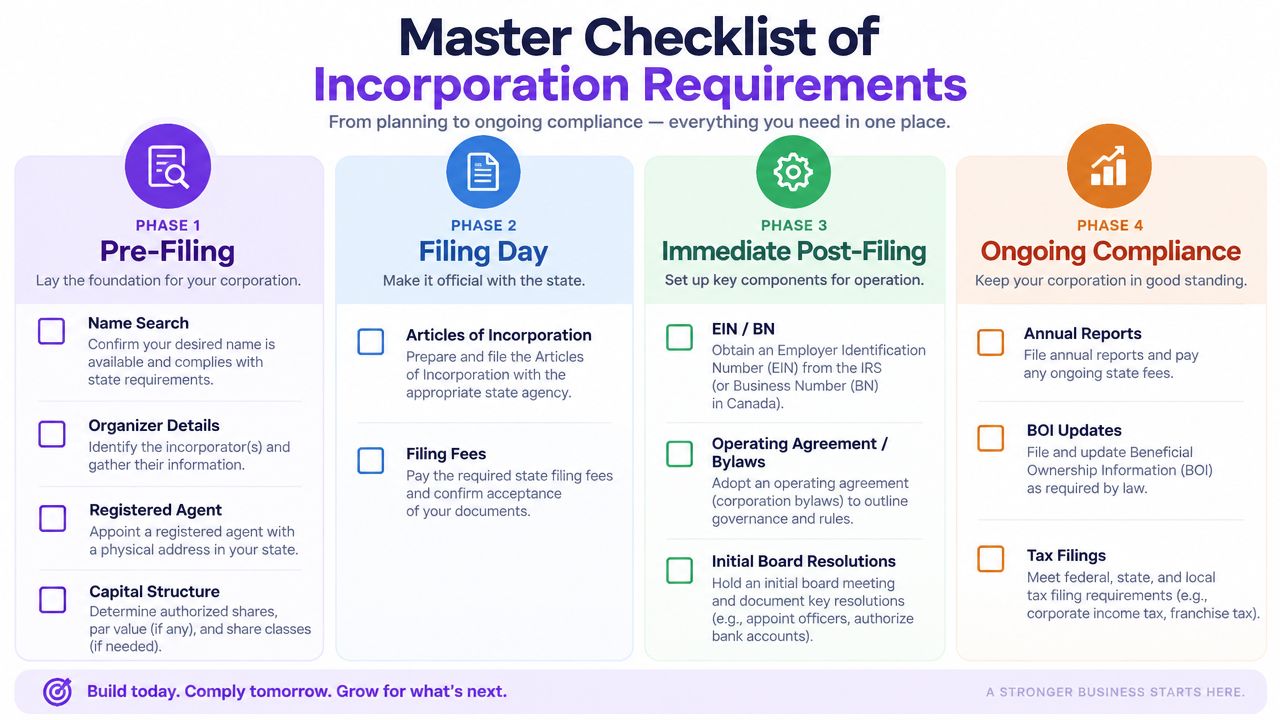
The certificate is not the first item on a real incorporation timeline. It's the point at which the compliance sequence becomes enforceable.
Founder Questions After the Checklist
Can a founder incorporate remotely? Often, yes, but remote formation doesn't remove identity verification, registered-office, ownership-reporting, or document-authentication requirements. Banks and foreign authorities may still request certified records or apostilles.
Are nominee directors or shareholders safe? They can create serious disclosure and banking risk when they obscure control structure. Any nominee arrangement should be reviewed by local counsel before filing, especially where residency rules affect director eligibility.
How can a team compress a two-week deadline? Run name checks, governance drafting, ownership mapping, tax-registration preparation, and bank-document collection in parallel. Keep sequential dependencies intact, and use a qualified virtual legal assistant for document coordination when counsel should focus on structural or tax issues.
Credit for Startups helps founders compare more than $3,000,000 in credits, perks, grants, and non-dilutive funding opportunities that can support the post-incorporation operating stack. Visit Credit for Startups to find relevant programs, review eligibility and application paths, and preserve runway after the company is formed.
